

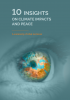
New report for policymakers provides an overview of the growing research on the links between climate change, security and peace. The synthesis identifies ten insights into climate-related security risks and lays the groundwork for the 'Global Climate Security Risk and Foresight Assessment', led by adelphi and PIK, that will be launched at the Berlin Climate and Security Conference.
Climate change is one of the most pressing political issues of our time. The unprecedented nature and scale of its impacts on people, economies and ecosystems worldwide are becoming clearer as science advances. One critical dimension of these impacts are their effect on international peace and security.
Yet to-date, the knowledge base on climate and security has remained dispersed and patchy, leaving policy makers unclear about how to grapple with this urgent issue. This new report synthesises and contextualises the existing scientific evidence to set out ten insights, which brief policymakers on the current knowledge of security risks related to climate change.
The ten insights, ranging from the peace and security implications of climate impacts on livelihoods and human mobility, to the unintended consequences of poorly designed climate and security policies themselves, lay the groundwork for the German Foreign Office-supported Global Climate Security Risk and Foresight Assessment that will be launched at the Berlin Climate and Security Conference.
The implication of these insights is that, if we do not act swiftly, climate change will mean more fragility, less peace and less security. The risks that climate change presents to international peace and security need to be addressed across the entire impact chain: by mitigating climate change, attenuating its consequences on ecosystems, adapting socio-economic systems, better managing the heightened resource competition climate change will bring about and by strengthening governance and conflict management institutions to cope with the changes in store without violence. The first step to all of this is a robust and authoritative risk assessment. The first outputs of the Global Climate Security Risk and Foresight Assessment will be published in 2021.
|
Access the Key Facts: |
Access the Executive Summary: |
![]() |
![]() |
European peatlands could turn from carbon sinks to sources as a quarter have reached levels of dryness unsurpassed in a record stretching back 2,000 years, according to a new study. This trend of “widespread” and “substantial” drying corresponds to recent climate change, both natural and human-caused, but may also be exacerbated by the peatlands being used for agriculture and fuel.
The Kingdom of the Netherlands has contributed $28 million to back FAO's work to boost the resilience of food systems in Somalia, Sudan, and South Sudan - part of a new initiative to scale-up resilience-based development work in countries affected by protracted crises.
A group of five small countries have announced that they will launch negotiations on a new Agreement on Climate Change, Trade and Sustainability, which, if successful, would constitute the first international trade agreement focused solely on climate change and sustainable development. The initiative also breaks new ground by aiming to simultaneously remove barriers for trade in environmental goods and services and crafting binding rules to eliminate fossil fuel subsidies. Small countries can pioneer the development of new trade rules that can help achieve climate goals, but making credible commitments, attracting additional participants, and ensuring transparency will be essential ingredients for long-term success.
Ten years after committing to phase out fossil fuel subsidies, G20 countries still subsidise coal, oil and gas to the tune of around USD 150 billion annually. Peer review of fossil fuel subsidies help push the G20 forward on this issue, but these reviews need to be followed by action. Subsidy reforms could free up resources that could be channeled back into government programmes and on accelerating a clean energy transition.