

6 Questions on Hurricane Irma, Harvey and Climate Change

A third of the way into the 2017 Atlantic hurricane season, NOAA looked at the ocean and air temperatures and issued an ominous new forecast: the region would likely experience "an above normal hurricane season" that "could be extremely active," with more named storms than previously expected—14 to 19 this season—and two to five major hurricanes.
Now, halfway through the season, Hurricane Harvey's destruction stretches along the Texas coast, and Hurricane Irma looks likely to make landfall in Florida after causing mass destruction in the Caribbean. Just a few days behind Irma, Hurricane Jose appears to be following the same deadly path, while Hurricane Katia churns off Mexico's eastern coast.
As global temperatures continue to rise, climate scientists have said this is what we should expect—more huge storms, with drastic impacts. Though scientists are still wrestling with some of the specifics of how climate change is impacting hurricanes, a lot is known, including the fact that hurricane seasons like this one could be the new norm.
What's So Extraordinary about These Storms?
Records are tumbling in quick succession this year. Irma, among the strongest Atlantic hurricanes on record, is barreling over the islands of the Caribbean as a Category 5 storm this week, while Houston, Texas, is still draining from Harvey's five-day deluge that broke the continental U.S. rainfall total for a single event.
Major storms are falling outside their normal range (Irma is the easternmost on record), and at strange times of the year (Tropical Storm Arlene hit in April of this year—one of only two named tropical storms in April, and the northernmost on record for that time of year). As climate change progresses, scientists aren't projecting an increase in total storms, but they are expecting a jump in the number of major storms—just like we're seeing now.
What Does Climate Change Have to Do with It?
If Hurricane Harvey had happened at the end of the 20th century, that amount of rain that falling in Houston in a single storm would have been rare—a 1-in-2,000-year event, said Kerry Emanuel, an MIT professor of atmospheric sciences. But as temperatures continue to rise, those rare events are becoming increasingly less rare, he said.
There are myriad reasons why individual storms develop as they do, including a combination of natural and manmade causes. That can make it hard to assess what role climate may have played in an individual storm (though the science behind attribution studies is getting better all the time). What scientists who study hurricanes are confident in, though, is the underlying physics that show that warmer temperatures are among the factors changing the way that storms form.
According to the 2014 National Climate Assessment, the intensity, frequency and duration of North Atlantic hurricanes have increased since the early 1980s. The frequency of the strongest storms—category 4 and 5 hurricanes—has increased too.
How Do Warmer Oceans Feed Hurricanes?
NOAA releases its annual Atlantic hurricane outlook each spring, in advance of the hurricane season that starts on June 1. This year, the agency had to update that outlook in August with an expectation of even more storms, due in part to warmer surface water temperatures. Surface temperatures in the eastern half of the tropical Atlantic Ocean were between 0.5°C and 1°C above average this summer, as the NOAA maps below of the sea surface temperature (SST) anomalies from mid-July to early September show.
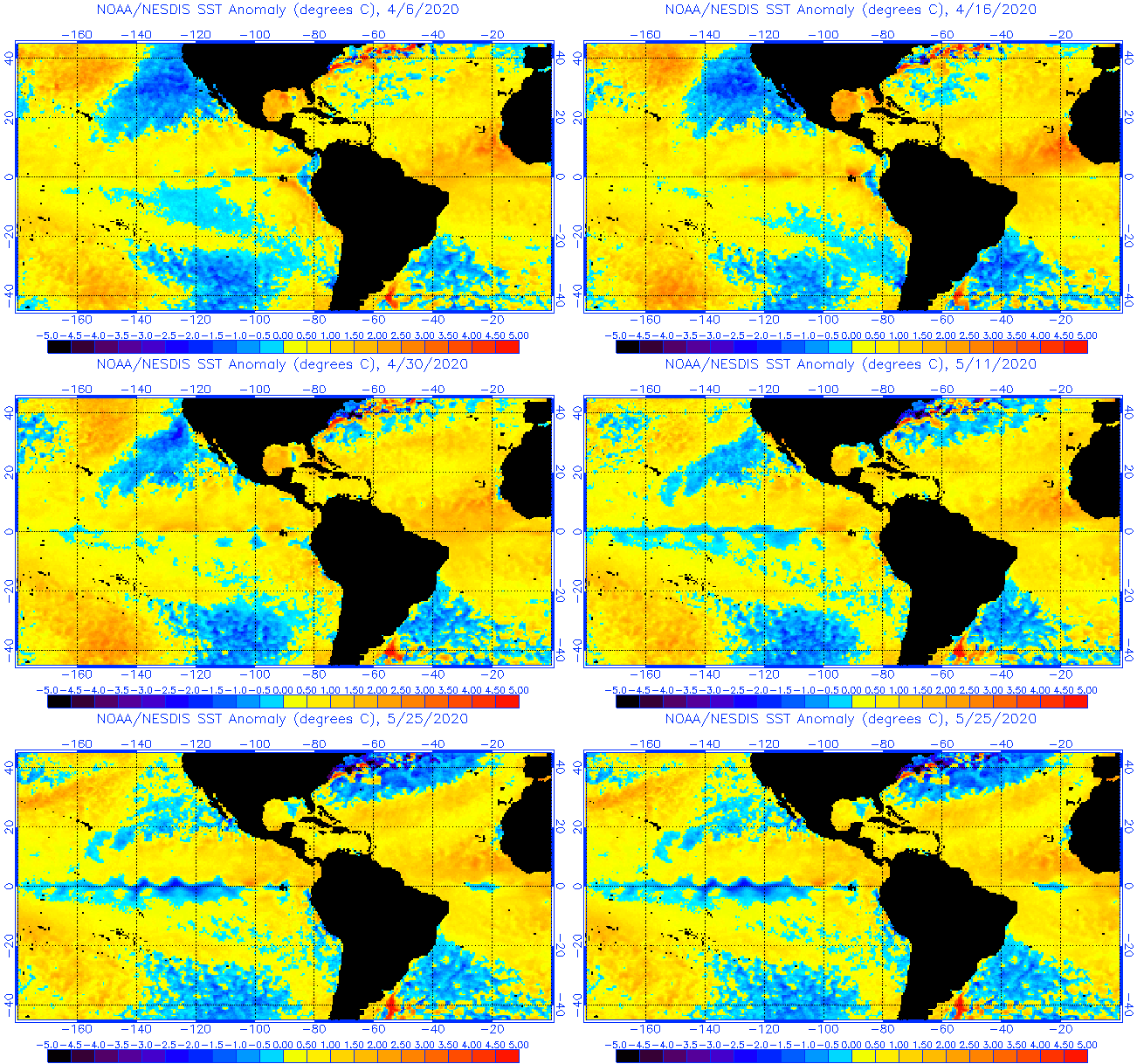
Those higher temperatures (as well as higher temperatures in the atmosphere) feed the storms, helping them strengthen. One study based on two decades of data found that hurricanes intensify significantly faster now than they used to. The researchers found that storms reach Category 3 wind speeds nine hours faster than they did in the 1980s.
Why So Much Rainfall in Houston?
Those higher temperatures don't just result in more intense wind speeds. Warmer air also retains more water vapor, which can result in dramatic rainfall like what happened during Hurricane Harvey.
In the case of Harvey, the rain volume was exacerbated by the fact that the storm stalled over the Houston area, bringing days of relentless downpours. The storm was surrounded by two high pressure systems, which essentially locked the storm in place. "Meteorologically, Southeast Texas, at the time, was pretty much a giant stop sign," Weather.com meteorologist Jonathan Belles told the Houston Chronicle. By the time the storm moved out, the National Weather Service had recorded 51.88 inches of rain near Mont Belvieu, Texas—a record for rainfall from a single storm in the continental U.S.
This stalling is a frequent feature of extreme events, but at this point, scientists have not found a conclusive link to climate change. There may be a connection, though, according to climate scientist Michael Mann. "More tenuous, but possibly relevant still, is the fact that very persistent, nearly 'stationary' summer weather patterns of this sort, where weather anomalies (both high pressure dry hot regions and low-pressure stormy/rainy regions) stay locked in place for many days at a time, appears to be favored by human-caused climate change," he wrote in a Facebook post late last month.
In a study published online in the journal Nature in March, Mann and coauthors wrote that amplified warming in the Arctic driven by anthropogenic climate change may be leading to an increase in extreme weather events that linger in once place for extended periods of time.
What Are the Biggest Threats from Irma?
The big fear with Irma is the wind. The National Hurricane Center was reporting sustained winds of 185 mph on Wednesday and gusts even higher. Those wind speeds are similar to Hurricane Wilma, the 2005 storm that resulted in at least 62 deaths and an estimated $29.4 billion in damage, of which $21 billion occurred in the United States.
Another concern is the storm surge that can accompany hurricanes. Riding on top of sea levels that have risen due to climate change, Irma's surge could be particularly dangerous. The National Hurricane Center warned Wednesday of storm surges as high as 20 feet above normal tide levels in the Turks and Caicos Islands and the Southeastern Bahamas.
What About that 'Hurricane Drought' Claim?
On Aug. 25, as Hurricane Harvey gained strength and headed for the Texas coast, the conservative Heartland Institute put out a press release decrying any efforts that scientists and the media might make to explain the climate influences on the storm. Bette Grande, a research fellow with Heartland, said: "Though it has been nearly 12 years since a major hurricane has hit the United States—Harvey will be creatively spun to 'prove' there are dire effects linked to man-created climate change." She was referring to the concept of a so-called "hurricane drought" that climate deniers have been circulating—which they say debunks the work of climate scientists.
While no "major hurricanes" made landfall in the United States between 2005 and this year, those weren't weak tropical storm years—the biggest storms just didn't hit the U.S. In 2013, Typhoon Haiyan devastated the Philippines with the highest wind speeds ever seen—until Hurricane Patricia broke that record two years later off Mexico's Pacific Coast, and several other cyclones wreaked havoc elsewhere around the world in the intervening years.
In a 2015 study published in the journal Geophysical Research Letters, two NASA scientists concluded that the lack of major storms in the United States during that period was merely "a matter of luck." People in some parts of the United States might also disagree with the concept of a "hurricane drought" during that period. "Tell the people of coastal Texas that Ike was not a major hurricane," said Emanuel, the MIT scientist. "Well, Ike was technically just under the ranking of major hurricane, and it completely destroyed a huge part of coastal Texas. Now, tell the people of New York that Sandy wasn't a major hurricane." "There were plenty of hurricanes in that stretch of 12 years," he said. "They just didn't happen to make landfall as strong storms in the United States."
[This article originally appeared on insideclimatenews.org]
Sabrina Shankman is a producer and reporter for InsideClimate News.
Inside Climate News is a Pulitzer Prize-winning, nonprofit, nonpartisan news organization that provides essential reporting and analysis on climate change, energy and the environment, for the public and for decision makers.



