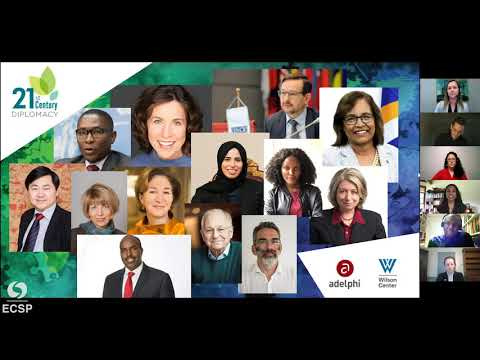
The best resource for all of our 21st Century Diplomacy: Foreign Policy Is Climate Policy content is the official website, hosted by the Wilson Center and adelphi. But the ECC editors are also collecting the topics here for eager readers.
The actions of the United States, China, and India will largely determine climate’s impact on the globe. At the same time, climate change is already influencing today’s era of great power competition and redefining the landscape of global leadership.
The climate crisis lays bare issues of inequity and injustice. Those least responsible for climate change are most vulnerable to its impacts. How can the foreign policy community accelerate and align efforts to address climate change with the global rallying cry for a more equitable and just world?
The Paris Agreement and UNFCCC process remains the primary avenue for current climate efforts and nation-state-to-nation-state diplomacy. This traditional mode of diplomacy is indispensable, but neglects the transformative power of sub- and non-state actors that are teaming up to take progressive action and form new leadership coalitions. What do these new modes of multilateralism mean for 21st century diplomacy?
Storm surges leave people stranded in their homes. Climate change can leave billion-dollar assets and entire sectors stranded, their value eroded by the changing economic landscape. Central banks, insurers, and financial regulators need to account for climate risk, including in international negotiations.
Decarbonizing the global energy system could spare every country from the most damaging climate impacts. However, universal benefits are not equal benefits, and the balance of power and relations between states will inevitably shift. What will the new geopolitical landscape look like?
Climate change is already a key driver in people’s decisions to move. The current foreign policy narrative on climate-affected migration focuses on security threats, border controls, and refugee management. But to empower those who are at the climate and mobility crossroads to enjoy meaningful choices, the diplomatic community will need to facilitate the protection of life and dignity, whether individuals and communities are on the move or choosing to stay in place.
Geoengineering is deliberate large-scale intervention in the Earth’s natural systems to combat climate change. Solar radiation management (SRM) is arguably the most likely technology to be deployed. An appealing technology option for some and risky endeavor for many, the lack of international norms or regulations on SRM research and deployment is a pressing diplomatic priority.
Using a progressive environmental security concept can help to tackle a range of environmental issues related to armed conflict, such as deforestation, loss of biodiversity, tensions over natural resources, conflict pollution, and damage to ecosystems. The environment can actually play a role in peacebuilding. This article briefly outlines why such an inclusive and environmental protection approach is needed and how it could be implemented.
Climate action and free trade have been perceived as contrary agendas for a long time. Despite more and more governments seeing tremendous potential for win-win outcomes, aligning trade and climate has become harder. This is due to changes in our current geopolitical landscape, as Christian Hübner explains in light of the upcoming G20 summit.
Human activity has caused the temperature of the Earth and its atmosphere to rise by about 1°C above pre-industrial levels, triggering fundamental changes to the planet’s physical and social landscapes. On 8 October an Intergovernmental Panel on Climate Change warned that temperatures were rising faster than expected, and that 1.5°C above pre-industrial levels could occur as early as 2030.
A recently published paper by the Stockholm International Peace Research Institute (SIPRI) has focused on the under-researched topic of how climate change impacts may affect violence in South and Southeast Asia. Titled “Climate change and violent conflict: Sparse evidence from South Asia and South East Asia”, the report highlights how little work has been done in looking at climate change and its possible impact on security in the most densely populated regions on the planet.