

Conflict Transformation
Global Issues
woman, bottled water, desert
© Stella Schaller/adelphi

In 2020 the European Peacebuilding Liaison Office (EPLO), together with adelphi and the Climate Diplomacy initiative, with support from the German Federal Foreign Office, organised two series of online workshops. The series brought together civil society experts and policymakers to discuss challenges, lessons learned, best practices and recommendations relating to how to address the linkages between climate change, conflict and peace.

The discussions were focused in particular on how to integrate peacebuilding efforts and climate resilience programming, including through initiatives bringing communities together to address the effects of climate change and prevent conflict. A report presents the key points from the discussions in the eight workshops in the series, while a policy brief presents a summary of the key points and recommendations.

Download the serie's policy brief and the full report.


Recordings are available for two of the serie's sessions:

24 September 2020 - Community Resilience to Climate Change and Conflict: Lessons From the Pacific
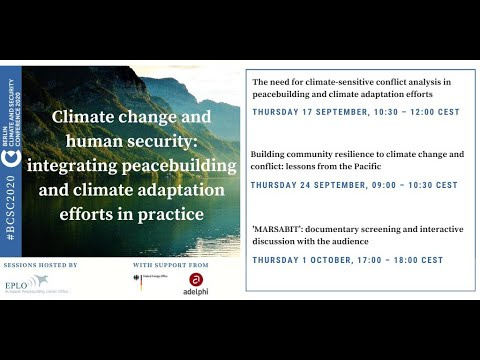
01 October 2020 - MARSABIT: Documentary Screening & Interactive Discussion

Source:
EPLO

Climate Diplomacy
Global Issues
Dennis Tänzler, adelphi
It’s crunch time for the global climate security discourse. While the COVID-19 crisis remains the key present challenge, it’s time to take stock of where the debate stands on the security implications of climate change in the run-up to another debate in the United Nations Security Council (UNSC) scheduled for July 2020. The Berlin Climate Security Conference series initiated a year ago with a call for action complements the UNSC debate...
Conflict Transformation
Global Issues
adelphi

New report for policymakers provides an overview of the growing research on the links between climate change, security and peace. The synthesis identifies ten insights into climate-related security risks and lays the groundwork for the Global Climate Security Risk and Foresight Assessment, led by adelphi and PIK, that will be launched at the Berlin Climate and Security Conference.

Ariana Barrenechea, Sophia Christina Tomany and Teslin Maria Augustine, with contributions from Abhishek Raj, John Chrysostom Kamoga, Nadja Macherey, Sonia Ran and Varad Vatsal (Willy Brandt School of Public Policy, University of Erfurt)

In the wake of Germany’s United Nations Security Council (UNSC) presidency for the month of July 2020, its role in addressing climate change in the body gains even greater importance. A look into selected UNSC members that are also pushing the climate issue reveals: health and economic risks are key entry-points.

Dhanasree Jayaram, MAHE

It’s official: India has been elected as a non-permanent member of the United Nations Security Council (UNSC) for 2021-22. Previously, the country has adopted a cautionary approach towards climate security. While it may not significantly shift its positions, global realities may trigger more openness, with an eye on multilateralism, rule of law and fairness.