

In 2020 the European Peacebuilding Liaison Office (EPLO), together with adelphi and the Climate Diplomacy initiative, with support from the German Federal Foreign Office, organised two series of online workshops. The series brought together civil society experts and policymakers to discuss challenges, lessons learned, best practices and recommendations relating to how to address the linkages between climate change, conflict and peace.
The discussions were focused in particular on how to integrate peacebuilding efforts and climate resilience programming, including through initiatives bringing communities together to address the effects of climate change and prevent conflict. A report presents the key points from the discussions in the eight workshops in the series, while a policy brief presents a summary of the key points and recommendations.
24 September 2020 - Community Resilience to Climate Change and Conflict: Lessons From the Pacific
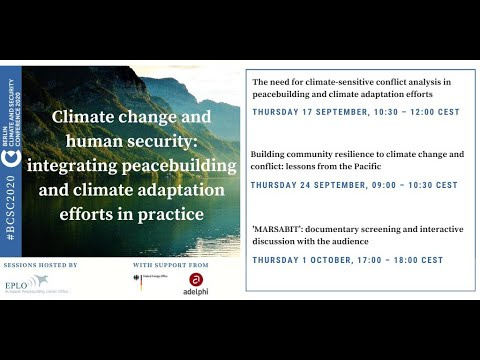
01 October 2020 - MARSABIT: Documentary Screening & Interactive Discussion
Climate change is increasingly challenging global security and undermining peacebuilding efforts. UN Environment and the European Union have joined forces to address these challenges. With the support of adelphi, they have developed a toolkit on ‘Addressing climate-fragility risks’. This toolkit facilitates the development and implementation of strategies, policies, and projects that seek to build resilience by linking climate change adaptation, peacebuilding, and sustainable livelihoods, focusing on the pilot countries Sudan and Nepal.
The new study Shoring up Stability demonstrates, for the first time, how climate change interacts with conflict and exacerbates the humanitarian crisis in the Lake Chad region. To launch the report and discuss its findings with local policy-makers, experts and practitioners, the German Embassy in Niger, adelphi and CNESS co-organised a launch event on 24 October in Niamey. Insights from Niger point to the importance of investing in governance rather than technical fixes.
Nobody needs to be convinced that climate change affects our very existence and security. However, experts are interested to know how climate change affects security at a global level and what the EU can do in that regard. This was the main aim of the European Security and Defence College (ESDC) Climate Change and Security Course co-organised by the French Institute for Higher National Defence Studies (IHEDN) and adelphi, as part of the Climate Diplomacy initiative supported by the German Federal Foreign Office, which took place in Brussels from 21 to 23 October 2019.
Even as the US officially pulled out of the Paris Agreement earlier this week, it might be too soon to lose hope on the country's long-term commitments to climate action. If a Democrat wins the upcoming presidential elections, which are set for November 2020, a reaccession process could begin shortly after the withdrawal is complete. In the meantime, however, the effect on trade policy could be significant.