

Conflict Transformation
Global Issues
woman, bottled water, desert
© Stella Schaller/adelphi

In 2020 the European Peacebuilding Liaison Office (EPLO), together with adelphi and the Climate Diplomacy initiative, with support from the German Federal Foreign Office, organised two series of online workshops. The series brought together civil society experts and policymakers to discuss challenges, lessons learned, best practices and recommendations relating to how to address the linkages between climate change, conflict and peace.

The discussions were focused in particular on how to integrate peacebuilding efforts and climate resilience programming, including through initiatives bringing communities together to address the effects of climate change and prevent conflict. A report presents the key points from the discussions in the eight workshops in the series, while a policy brief presents a summary of the key points and recommendations.

Download the serie's policy brief and the full report.


Recordings are available for two of the serie's sessions:

24 September 2020 - Community Resilience to Climate Change and Conflict: Lessons From the Pacific
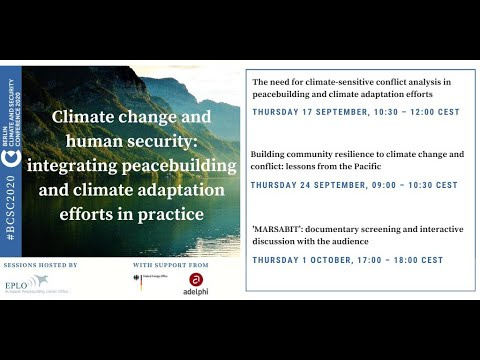
01 October 2020 - MARSABIT: Documentary Screening & Interactive Discussion

Source:
EPLO

Climate Change
Land & Food
Europe
Global Issues
Josh Gabbatiss, Carbon Brief

European peatlands could turn from carbon sinks to sources as a quarter have reached levels of dryness unsurpassed in a record stretching back 2,000 years, according to a new study. This trend of “widespread” and “substantial” drying corresponds to recent climate change, both natural and human-caused, but may also be exacerbated by the peatlands being used for agriculture and fuel.

Adaptation & Resilience
Capacity Building
Conflict Transformation
Development
Finance
Land & Food
Middle East & North Africa
Planetary Security Initiative

The Kingdom of the Netherlands has contributed $28 million to back FAO's work to boost the resilience of food systems in Somalia, Sudan, and South Sudan - part of a new initiative to scale-up resilience-based development work in countries affected by protracted crises.

Harro van Asselt, IISD

A group of five small countries have announced that they will launch negotiations on a new Agreement on Climate Change, Trade and Sustainability, which, if successful, would constitute the first international trade agreement focused solely on climate change and sustainable development. The initiative also breaks new ground by aiming to simultaneously remove barriers for trade in environmental goods and services and crafting binding rules to eliminate fossil fuel subsidies. Small countries can pioneer the development of new trade rules that can help achieve climate goals, but making credible commitments, attracting additional participants, and ensuring transparency will be essential ingredients for long-term success.

Climate Change
Climate Diplomacy
Energy
Finance
Global Issues
Laura Merrill and Franziska Funke, IISD

Ten years after committing to phase out fossil fuel subsidies, G20 countries still subsidise coal, oil and gas to the tune of around USD 150 billion annually. Peer review of fossil fuel subsidies help push the G20 forward on this issue, but these reviews need to be followed by action. Subsidy reforms could free up resources that could be channeled back into government programmes and on accelerating a clean energy transition.