

In 2020 the European Peacebuilding Liaison Office (EPLO), together with adelphi and the Climate Diplomacy initiative, with support from the German Federal Foreign Office, organised two series of online workshops. The series brought together civil society experts and policymakers to discuss challenges, lessons learned, best practices and recommendations relating to how to address the linkages between climate change, conflict and peace.
The discussions were focused in particular on how to integrate peacebuilding efforts and climate resilience programming, including through initiatives bringing communities together to address the effects of climate change and prevent conflict. A report presents the key points from the discussions in the eight workshops in the series, while a policy brief presents a summary of the key points and recommendations.
24 September 2020 - Community Resilience to Climate Change and Conflict: Lessons From the Pacific
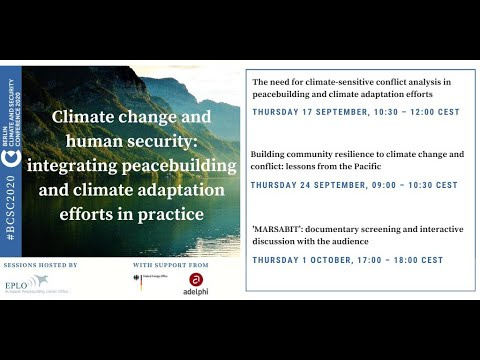
01 October 2020 - MARSABIT: Documentary Screening & Interactive Discussion
adelphi has relaunched its exhibition Environment, Conflict and Cooperation (ECC) Exhibition to illustrate how unprecedented environmental changes interact with social, political, and economic risks to exacerbate conflict. We invite you to explore our online exhibition and to learn more about urgent issues of our time: climate, energy, migration, extractives, food and water.
Climate security risks are, by all interpretations, a global threat. But when it comes to setting a political climate security agenda, a handful of countries stand out. In an interview with Climate Diplomacy, Michaela Spaeth, Director for Energy and Climate Policy at the German Federal Foreign Office, highlights some of Germany’s goals and challenges in forwarding the issue during its 2019-20 membership in the UN Security Council.
The Planetary Security Conference 2019, which concluded on 20 February, saw a number of workshops being held on the Sahel region and specifically Mali, one of the Conference’s three spotlight regions. These workshops examined the region’s climate-water-security risks as well as the #doable actions and solutions to address these issues.
Peatlands cover about 3% of the Earth’s land area, store huge amounts of carbon, and provide habitats for diverse flora and fauna. The recent UN Environment Assembly in Nairobi, Kenya, has adopted its first ever resolution on peatlands. A groundbreaking step!