

In 2020 the European Peacebuilding Liaison Office (EPLO), together with adelphi and the Climate Diplomacy initiative, with support from the German Federal Foreign Office, organised two series of online workshops. The series brought together civil society experts and policymakers to discuss challenges, lessons learned, best practices and recommendations relating to how to address the linkages between climate change, conflict and peace.
The discussions were focused in particular on how to integrate peacebuilding efforts and climate resilience programming, including through initiatives bringing communities together to address the effects of climate change and prevent conflict. A report presents the key points from the discussions in the eight workshops in the series, while a policy brief presents a summary of the key points and recommendations.
24 September 2020 - Community Resilience to Climate Change and Conflict: Lessons From the Pacific
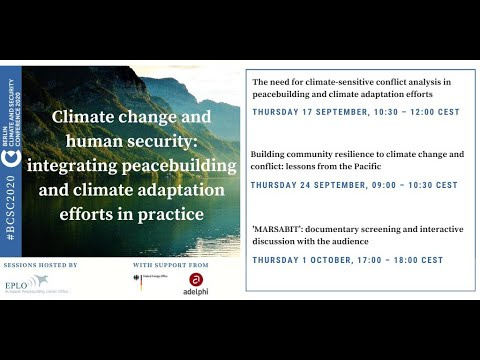
01 October 2020 - MARSABIT: Documentary Screening & Interactive Discussion
Times of war can result in rapid environmental degradation as people struggle to survive and environmental management systems break down resulting in damage to critical ecosystems. For over six decades, armed conflicts have occurred in more than two-thirds of the world’s biodiversity hotspots thus posing critical threats to conservation efforts. [...]
More than 4,700 delegates, including environment ministers, scientists, academics, business leaders and civil society representatives, met in Nairobi for the UN Environment Assembly, the world’s top environmental body whose decisions will set the global agenda, notably ahead of the UN Climate Action Summit in September.
Mid february, the EU's foreign affairs ministers welcomed the Commission’s strategic long-term vision for a climate neutral Europe. Ministers also called for urgent and decisive action to strengthen the global response on climate change and restated the EU’s determination to lead the way on accelerated climate action on all fronts.
In an increasingly urbanised world, global resilience cannot be achieved without cities. Separating a local from a national or international sustainability issue is increasingly difficult – be it climate change, migration, or economic development.