

In 2020 the European Peacebuilding Liaison Office (EPLO), together with adelphi and the Climate Diplomacy initiative, with support from the German Federal Foreign Office, organised two series of online workshops. The series brought together civil society experts and policymakers to discuss challenges, lessons learned, best practices and recommendations relating to how to address the linkages between climate change, conflict and peace.
The discussions were focused in particular on how to integrate peacebuilding efforts and climate resilience programming, including through initiatives bringing communities together to address the effects of climate change and prevent conflict. A report presents the key points from the discussions in the eight workshops in the series, while a policy brief presents a summary of the key points and recommendations.
24 September 2020 - Community Resilience to Climate Change and Conflict: Lessons From the Pacific
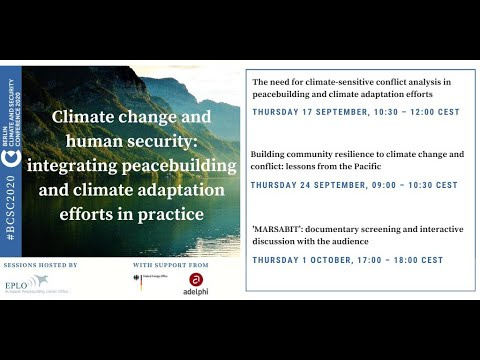
01 October 2020 - MARSABIT: Documentary Screening & Interactive Discussion
Japan will join the EU in aiming for net-zero emissions by 2050, Prime Minister Yoshihide Suga announced on Monday (26 October).
The best resource for all of our 21st Century Diplomacy: Foreign Policy Is Climate Policy content is the official website, hosted by the Wilson Center and adelphi. But the ECC editors are also collecting the topics here for eager readers.
What exactly triggers food riots? At which point does climate change come in? And what can we learn from analyzing the lack and impotence of government action in conflict areas? In our Editor’s Pick, we share 10 case studies from the interactive ECC Factbook that address the connections between food, the environment and conflict. They show how agriculture and rural livelihoods can affect stability in a country, which parties are involved in food conflicts and what possible solutions are on the table.
Tensions in the South China Sea increased last April when a Chinese coast guard ship sank a Vietnamese fishing boat near the Paracel Islands—a fiercely disputed territory in the South China Sea. Disputes over island territories in the region have endured for decades, with China, Vietnam, the Philippines, Taiwan, Indonesia, Malaysia, and Brunei all making overlapping territorial claims. The region is rich in natural resources and biodiversity, holding vast fish stocks and an estimated 11 billion barrels of oil and 190 cubic feet of natural gas.