

In 2020 the European Peacebuilding Liaison Office (EPLO), together with adelphi and the Climate Diplomacy initiative, with support from the German Federal Foreign Office, organised two series of online workshops. The series brought together civil society experts and policymakers to discuss challenges, lessons learned, best practices and recommendations relating to how to address the linkages between climate change, conflict and peace.
The discussions were focused in particular on how to integrate peacebuilding efforts and climate resilience programming, including through initiatives bringing communities together to address the effects of climate change and prevent conflict. A report presents the key points from the discussions in the eight workshops in the series, while a policy brief presents a summary of the key points and recommendations.
24 September 2020 - Community Resilience to Climate Change and Conflict: Lessons From the Pacific
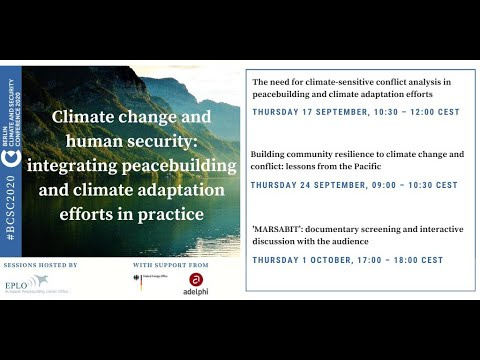
01 October 2020 - MARSABIT: Documentary Screening & Interactive Discussion
Using a progressive environmental security concept can help to tackle a range of environmental issues related to armed conflict, such as deforestation, loss of biodiversity, tensions over natural resources, conflict pollution, and damage to ecosystems. The environment can actually play a role in peacebuilding. This article briefly outlines why such an inclusive and environmental protection approach is needed and how it could be implemented.
Climate action and free trade have been perceived as contrary agendas for a long time. Despite more and more governments seeing tremendous potential for win-win outcomes, aligning trade and climate has become harder. This is due to changes in our current geopolitical landscape, as Christian Hübner explains in light of the upcoming G20 summit.
Human activity has caused the temperature of the Earth and its atmosphere to rise by about 1°C above pre-industrial levels, triggering fundamental changes to the planet’s physical and social landscapes. On 8 October an Intergovernmental Panel on Climate Change warned that temperatures were rising faster than expected, and that 1.5°C above pre-industrial levels could occur as early as 2030.
A recently published paper by the Stockholm International Peace Research Institute (SIPRI) has focused on the under-researched topic of how climate change impacts may affect violence in South and Southeast Asia. Titled “Climate change and violent conflict: Sparse evidence from South Asia and South East Asia”, the report highlights how little work has been done in looking at climate change and its possible impact on security in the most densely populated regions on the planet.