

Conflict Transformation
Global Issues
woman, bottled water, desert
© Stella Schaller/adelphi

In 2020 the European Peacebuilding Liaison Office (EPLO), together with adelphi and the Climate Diplomacy initiative, with support from the German Federal Foreign Office, organised two series of online workshops. The series brought together civil society experts and policymakers to discuss challenges, lessons learned, best practices and recommendations relating to how to address the linkages between climate change, conflict and peace.

The discussions were focused in particular on how to integrate peacebuilding efforts and climate resilience programming, including through initiatives bringing communities together to address the effects of climate change and prevent conflict. A report presents the key points from the discussions in the eight workshops in the series, while a policy brief presents a summary of the key points and recommendations.

Download the serie's policy brief and the full report.


Recordings are available for two of the serie's sessions:

24 September 2020 - Community Resilience to Climate Change and Conflict: Lessons From the Pacific
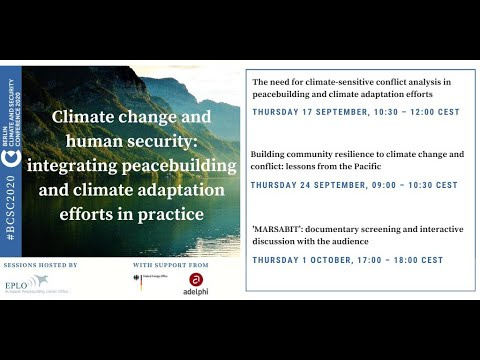
01 October 2020 - MARSABIT: Documentary Screening & Interactive Discussion

Source:
EPLO

Climate Change
Sustainable Transformation
Europe
Sam Morgan, Euractiv

Members of the European Parliament voted on Wednesday (10 October) in favour of increasing the EU’s Paris Agreement emissions pledge by 2020. They also urged the European Commission to make sure its long-term climate strategy models net-zero emissions for 2050 “at the latest”.

Adaptation & Resilience
Capacity Building
Climate Change
Sub-Saharan Africa
Central America & Caribbean
Middle East & North Africa
Asia
Josh Busby, Ashley Moran (UT Austin) and Clionadh Raleigh (ACLED)

A new USAID report focuses on the intersection of climate exposure and state fragility worldwide. It finds that the factors that make a country vulberable to large-scale conflict are similar to those that make it vulnerable to climate change. The report thus offers a way for global audiences with an interest in climate and security to identify places of high concern.

Climate Change
Global Issues
Dennis Tänzler, adelphi

A big difference. That was the conclusion the Intergovernmental Panel on Climate Change (IPCC) came to when it assessed the differences between a 1.5°C and a 2°C warmer world in a landmark special report published in early October. The leading scientific authority on climate change found that the world is likely to pass the 1.5 °C mark between 2030 and 2052 if current emission trends are not interrupted.

Moeen Khan, Pakistan Today

Pakistan’s unprecedented climate shocks make it clear: regional cooperation for managing shared waters is desperately needed. To halt the increasing impacts on agriculture and livelihoods that cripple the country’s economy, diplomacy is of paramount importance. In our interview, Moeen Khan explains how territorial and ethnic tensions with India hinder much-needed transboundary solutions – and how the international community can help.