

In 2020 the European Peacebuilding Liaison Office (EPLO), together with adelphi and the Climate Diplomacy initiative, with support from the German Federal Foreign Office, organised two series of online workshops. The series brought together civil society experts and policymakers to discuss challenges, lessons learned, best practices and recommendations relating to how to address the linkages between climate change, conflict and peace.
The discussions were focused in particular on how to integrate peacebuilding efforts and climate resilience programming, including through initiatives bringing communities together to address the effects of climate change and prevent conflict. A report presents the key points from the discussions in the eight workshops in the series, while a policy brief presents a summary of the key points and recommendations.
24 September 2020 - Community Resilience to Climate Change and Conflict: Lessons From the Pacific
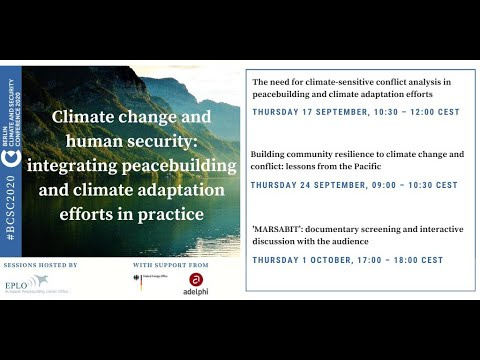
01 October 2020 - MARSABIT: Documentary Screening & Interactive Discussion
Russia’s economic development minister warned last week that the EU’s plans to deploy a carbon tax at the bloc’s borders will not be in line with World Trade Organisation (WTO) rules, just as Brussels doubled down on the idea of green tariffs.
Few places have suffered more from the COVID-19 pandemic than southern China, the region where the novel coronavirus was first detected in the city of Wuhan. But it turned out that the pandemic is not the only calamity to befall south China this year. The region has been inundated by heavy rainfall since late May, creating a risk of catastrophic flooding.
Natural resources-based conflicts are sometimes made complex by non-climate push and pull factors, like unemployment and political tension. These factors should be taken into account when developing and implementing a peacebuilding strategy, making sure all stakeholders are at the table – including those fueling the conflict. The online workshop ‘Integrating peacebuilding and climate change mitigation efforts in natural resource management’, organised by the European Peacebuilding Liaison Office (EPLO) and adelphi, looked into this complex issue.
A little over a decade ago, the Himalayan region was considered by the IPCC a 'black hole for data'. Small steps have been taken since then, but now scientists hope recent border clashes and the pandemic will not derail the limited progress made on research cooperation over the past decade.