

Nepal and Afghanistan face a number of serious climate-fragility risks, so adelphi brought together regional government officials and NGO experts for a training in Kathmandu on 9 November 2019.
Nepal and Afghanistan – as well as their South Asian neighbours - face a number of serious climate-fragility risks. For example, in Nepal, floods and landslides have made it harder for some people to make a living and forced them to consider migrating to other areas of the country. Meanwhile in Afghanistan, increasingly frequent droughts are encouraging farmers to resort to more drought-resistant crops, such as poppy plants, which can boost the drug economy.
In order to improve the region’s ability to adapt to climate change, adelphi, the UN Environment Programme (UNEP) and Practical Action Nepal brought together experts from the Afghani and Nepalese governments, as well as local and national civil society organisations, international organisations and donors, and the academia, to analyse and discuss the knock-on consequences of climate change.
The training, which took place at the Hotel Greenwich in Kathmandu on November 9th, was based on an Integrated Climate-Fragility Risk Assessment tool that links peacebuilding and climate change adaption, developed by UNEP and adelphi as part of the EU-funded Climate Change and Fragility project.
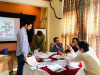
Participants highlighted the importance of addressing the social dimension of climate challenges and gave examples of specific experiences and projects at the nexus of climate and security. As Dr. Beatrice Mosello of adelphi put it, “It is important to understand how climate change interacts with other drivers or risk. Without quantifying these trends, the world will continue to underestimate the scale of climate change.”
This was just the first of several trainings and workshops in South Asia planned for the rest of 2019. Stay tuned for the launch of adelphi’s Climate Security Expert Network website, where you can find fact sheets and detailed risk reports on the climate-fragility risks in chosen countries.
Adapting to climate change and strengthening resilience are becoming priorities for the international community – however, they require greater ambition in climate policy. 107 governments and numerous international organisations have endorsed a call for action on raising ambition at the United Nations Climate Change Summit on 23rd September 2019. Following the summit, the Global Commission on Adaptation will begin its Year of Action to meet the climate challenges ahead. The Year of Action is here to accelerate climate adaptation around the world, to improve human well-being and to drive more sustainable economic development and security.
A new form of organized crime has recently been emerging in the Amazon: illegal mining. Miners fell trees, use high-grade explosives for blasting soils and dredge riverbeds. But the impacts go beyond environmental damage, bringing with it a slew of other social problems. Peace researcher Adriana Abdenur urges policymakers to improve coordination and argues that diplomacy may help prevent further conflicts, corruption and crime.
Access to water can be a critical resource for cooperation, but also a source of tension. Identifying risks before their onset is crucial for the efficiency and economic feasibility of intervention strategies, but how can these risks be measured? To address this conundrum, adelphi together with several partners convened a side-event at World Water Week, which connected experts developing analytical tools to policy makers in the water sector.
The severity of desertification and its mutual relationship with climate change cannot be overstated. In light of the recent launch of the Special Report on Climate Change and Land by the Intergovernmental Panel on Climate Change (IPCC), Robert McSweeney from Carbon Brief explains what desertification is, what role climate change plays, and what impact it has across the world.