

Climate Diplomacy
Early Warning & Risk Analysis
Asia
adelphi
Training, Nepal, climate, fragility, UNEP
© Beatrice Mosello/adelphi

Nepal and Afghanistan face a number of serious climate-fragility risks, so adelphi brought together regional government officials and NGO experts for a training in Kathmandu on 9 November 2019.

Nepal and Afghanistan – as well as their South Asian neighbours - face a number of serious climate-fragility risks. For example, in Nepal, floods and landslides have made it harder for some people to make a living and forced them to consider migrating to other areas of the country. Meanwhile in Afghanistan, increasingly frequent droughts are encouraging farmers to resort to more drought-resistant crops, such as poppy plants, which can boost the drug economy.

In order to improve the region’s ability to adapt to climate change, adelphi, the UN Environment Programme (UNEP) and Practical Action Nepal brought together experts from the Afghani and Nepalese governments, as well as local and national civil society organisations, international organisations and donors, and the academia, to analyse and discuss the knock-on consequences of climate change.

The training, which took place at the Hotel Greenwich in Kathmandu on November 9th, was based on an Integrated Climate-Fragility Risk Assessment tool that links peacebuilding and climate change adaption, developed by UNEP and adelphi as part of the EU-funded Climate Change and Fragility project.
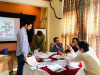
Training, Nepal, climate fragility, UNEP
© Beatrice Mosello/adelphi


Participants highlighted the importance of addressing the social dimension of climate challenges and gave examples of specific experiences and projects at the nexus of climate and security. As Dr. Beatrice Mosello of adelphi put it, “It is important to understand how climate change interacts with other drivers or risk. Without quantifying these trends, the world will continue to underestimate the scale of climate change.”

This was just the first of several trainings and workshops in South Asia planned for the rest of 2019. Stay tuned for the launch of adelphi’s Climate Security Expert Network website, where you can find fact sheets and detailed risk reports on the climate-fragility risks in chosen countries.


Biodiversity & Livelihoods
Conflict Transformation
Sub-Saharan Africa
UN Environment

Nigeria’s central Middle Belt region is home to a diverse cultural population of semi-nomadic cattle herders and farming communities. For decades, the region has experienced increasingly violent attacks that have been partially attributed to direct competition over access and use of natural resources.

Dennis Tänzler, adelphi

COP24 starts today, the IPCC has published new scientific evidence on the devastating impacts of climate change, the probability that those changes will be manageable are decreasing, and, once again, there is a stalemate in international climate negotiations. Time is running out fast - or more appropriately, as UNFCCC Executive Secretary Espinosa stressed, time is a luxury we no longer have. So, actually the question is how soon is now?

Climate Diplomacy
Global Issues

COP24 might be in Katowice, but for the rest of the world it’s on Twitter. Navigating through this sea of news and expert profiles is not the easiest task, however. With this is mind, we’d like to share our favourite Twitter accounts with our followers so that you can be up-to-date throughout the event.

Conflict Transformation
Security
Water
Global Issues
Adrien Detges, adelphi and Tobias Ide, Georg Eckert Institute

Although water is an essential input for agriculture and industrial production, it is also scarce in many regions. When it crosses international borders via shared rivers, lakes and aquifers, it can become a source of conflict and contention. Yet while water can be a source of instability, especially in the face of climate change, it can also be a source or catalyst for cooperation and even peace.