


Nobody needs to be convinced that climate change affects our very existence and security. However, experts are interested to know how climate change affects security at a global level and what the EU can do in that regard. This was the main aim of the European Security and Defence College (ESDC) Climate Change and Security Course co-organised by the French Institute for Higher National Defence Studies (IHEDN) and adelphi, as part of the Climate Diplomacy initiative supported by the German Federal Foreign Office, which took place in Brussels from 21 to 23 October 2019.
The course continued the main narrative of last year’s high-level event “Climate, peace and security: the time for action” convened by the High Representative/Vice-President Federica Mogherini, namely that climate security has emerged as an important foreign policy issue. It also highlighted the fact that the European Union needs to connect climate change policies with crisis prevention and peacebuilding initiatives as well as integrate these efforts within existing regional and sectoral policies in order to help safeguard international security and stability.
To this end, the course gave participants the opportunity to consider and work on a number of specific themes, and to assess global climate change scenarios and the risks that these present for peace and international security. Particular attention was given to key international and European actors, policies and critical debates in the climate change and security context. It was also recognised that climate change will indirectly affect the role of our armed forces, which will be given new missions.
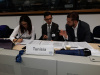
One of the most interactive sessions was the simulation of a meeting of the United Nations Security Council (UNSC) in which the UNSC debated a resolution on the impact of climate change on international peace and security. The simulation explored the potential security risks of climate change as well as the diverging positions and interests of member states regarding UNSC action. The exercise gave participants first-hand experience of the dynamics and sensitivities related to the issue of climate change and security within the UNSC.
The very last session of the course was both challenging and practical. The course moderator asked them to assess how climate security considerations might be better integrated into their professional life. The question prompted participants to think in a very pragmatic way and made them aware that climate-sensitive behaviour matters at individual level, on a daily basis, and needs to be part of everyone’s working routine. The group was very well balanced: twenty-seven women and thirty men, with various professional backgrounds from EU member states and institutions attended the course.
[This article originally appeared on esdc.europa.eu]


