

Escazú Agreement, LAC's first environmental treaty, gains momentum

The move means only three more ratifications are needed for the regional agreement to enter into force. The agreement initially opened for signatures during the UN General Assembly in September 2018 following three years of negotiations under the supervision of the UN’s Economic Commission for Latin America and the Caribbean (ECLAC).
Fourteen more countries are pending ratification. This includes Colombia, which eventually signed in December 2019, revising its original resistance to the pact after mounting public pressure and protests.
The rationale behind the Escazú Agreement is that access to information in Latin America remains poor, there is widespread impunity for crimes against environmental defenders, and communities’ right to consultation on the impacts of large development projects are often disrespected.
So why is the agreement still important, and what progress has it made?
Why does the Escazú Agreement matter?
- It seeks to give citizens more comprehensive access to information on environmental issues, including on major development projects.
- It promotes greater citizen participation in environmental decisions.
- It affords citizens greater access to justice in environmental matters.
- It aims to prevent, investigate and punish all attacks against defenders of environmental rights. It is the first international treaty that contemplates specific protection measures.
How is the Agreement advancing?
- Eleven of Latin America and the Caribbean’s 33 countries need to ratify the agreement for it to enter into force.
- Eight countries have already ratified: Antigua and Barbuda, Bolivia, Guyana, Nicaragua, Panama, Saint Kitts and Nevis, Saint Vincent and the Grenadines, and Uruguay.
- 14 countries have signed but have not yet ratified: Argentina, Brazil, Colombia, Costa Rica, Ecuador, Granada, Guatemala, Haiti, Jamaica, Mexico, Paraguay, Peru, Dominican Republic and Saint Lucia.
- 11 countries have not signed: Bahamas, Barbados, Belize, Chile, Cuba, Dominica, El Salvador, Honduras, Suriname, Trinidad and Tobago, and Venezuela.
- One publicly stated it will not sign: Chile.
Why do environmental leaders need Escazú?
- Six of the top 10 most dangerous countries in the world for environmental defenders are in Latin America: Brazil, Colombia, Guatemala, Honduras, Mexico and Peru.
- 48% of 135 communications sent in 2016 to governments and companies on violence against environmental defenders by Michel Forst, the UN’s Special Rapporteur on Human Rights, related to cases in the region.
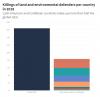
- According to NGO Global Witness, 164 environmental defenders were killed in 2018 globally. More than half of killings took place in Latin America, the most violent region for environmental defenders since they began compiling the report in 2012.
- Colombia, Brazil, Guatemala and Mexico are among the deadliest 6 countries. While Honduras, Venezuela and Chile also recorded murders.
- For the first time since 2012 Brazil did not top the list, although it did appear fourth. Guatemala saw the number of murders multiply fivefold, which made it the most dangerous country per capita.
The journalistic project ‘Land of Resistants’, which brought together more than 35 journalists from seven countries, investigated the situation facing environmental defenders in Bolivia, Brazil, Colombia, Ecuador, Guatemala, Mexico and Peru. It found:
- At least 1,356 attacks and incidences of violence against environmental defenders between 2009 and 2018 in those seven countries
- 56% of attacks were targeted at people belonging to ethnic minorities, demonstrating that the territories of indigenous and Afro-descendant peoples are especially vulnerable
- Conclusive data on sentences (either convictions or acquittals) in just 50 cases (or 3.68% of the total), proving that justice is very unevenly applied. Sentences were mostly given to hitmen or direct perpetrators, not the masterminds behind them.
- In at least 545 attacks (or 40% of the total), victims or their communities had expressed security concerns to the authorities, whether state institutions or international instances such as the Commission or the Inter-American Court of Human Rights.
[This article originally appeared on Diálogo Chino.]


