


Desertification has been described as the “the greatest environmental challenge of our time” and climate change is making it worse. While the term may bring to mind the windswept sand dunes of the Sahara or the vast salt pans of the Kalahari, it’s an issue that reaches far beyond those living in and around the world’s deserts, threatening the food security and livelihoods of more than two billion people. The combined impact of climate change, land mismanagement and unsustainable freshwater use has seen the world’s water-scarce regions increasingly degraded. This leaves their soils less able to support crops, livestock and wildlife.
This week, the Intergovernmental Panel on Climate Change (IPCC) has published its special report on climate change and land. The report, written by hundreds of scientists and researchers from across the world, dedicates one of its seven chapters solely to the issue of desertification. In light of the report, Carbon Brief looks at what desertification is, the role that climate change plays and what impact it is having around the world.
Defining desertification
In 1994, the UN established the United Nations Convention to Combat Desertification(UNCCD) as the “sole legally binding international agreement linking environment and development to sustainable land management”. The Convention itself was a response to a call at the UN Earth Summit in Rio de Janeiro in 1992 to hold negotiations for an international legal agreement on desertification.
The UNCCD set out a definition of desertification in a treaty adopted by parties in 1994. It states that desertification means “land degradation in arid, semi-arid and dry sub-humid areas resulting from various factors, including climatic variations and human activities”.
So, rather than desertification meaning the literal expansion of deserts, it is a catch-all term for land degradation in water-scarce parts of the world. This degradation includes the temporary or permanent decline in quality of soil, vegetation, water resources or wildlife, for example. It also includes the deterioration of the economic productivity of the land – such as the ability to farm the land for commercial or subsistence purposes.
Arid, semi-arid and dry sub-humid areas are known collectively as “drylands”. These are, unsurprisingly, areas that receive relatively little rain or snow each year. Technically, they are defined by the UNCCD as “areas other than polar and sub-polar regions, in which the ratio of annual precipitation to potential evapotranspiration falls within the range from 0.05 to 0.65”.
In simple terms, this means the amount of rainfall the area receives is between 5-65% of how much it loses through evaporation and transpiration from the land surface and vegetation, respectively. Any area that receives more than this is referred to as “humid”.
You can see this more clearly in the map below, where the world’s drylands are identified by different grades of orange and red shading. Drylands encompass around 38% of the Earth’s land area, covering much of North and southern Africa, western North America, Australia, the Middle East and Central Asia. Drylands are home to approximately 2.7 billion people (pdf) – 90% of whom live in developing countries.
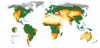
Drylands are particularly susceptible to land degradation because of scarce and variable rainfall as well as poor soil fertility. But what does this degradation look like?
There are numerous ways in which the land can degrade. One of the main processes is erosion – the gradual breaking down and removal of rock and soil. This is typically through some force of nature – such as wind, rain and/or waves – but can be exacerbated by activities including ploughing, grazing or deforestation.
A loss of soil fertility is another form of degradation. This can be through a loss of nutrients, such as nitrogen, phosphorus and potassium, or a decline in the amount of organic matter in the soil. For example, soil erosion by water causes global losses of as much as 42m tonnes of nitrogen and 26m tonnes of phosphorus every year. On farmed land, this inevitably needs to be replaced through fertilisers at significant cost. Soils can also suffer from salinisation – an increase in salt content – and acidification from overuse of fertilisers.
Then there are lots of other processes that are classed as degradation, including a loss or shift in vegetation type and cover, the compaction and hardening of the soil, an increase in wildfires, and a declining water table through excessive extraction of groundwater.
[...]
Read the full article here.


