

Giving food back the value it deserves: a global fight against food losses and waste

Food is indeed a cornerstone of the delicate environmental balance of our planet and in the last decades it has become a frequent cause of inequality, splitting the world population into two classes: vulnerable citizens who don’t have access to healthy and nutritious food and those who can afford to throw it away. Yet, every year around 1.3 billion tons of food losses and waste (FLW) are being produced.
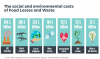
The social and environmental costs of food losses and waste
According to FAO, FLW causes around USD 2.6 trillion costs per year, provoking a huge carbon footprint, water stress, soil erosion, not to mention serious threats to biodiversity. FLW potentially generates impressive social costs that affect human welfare, health damages and the quality of life. Among others, they risk to trigger conflicts by provoking human, economic and environmental costs for around USD 400 billion each year. Similarly, the loss of livelihoods is evaluated at being around USD 333 billion per year. These challenges that an ever-populated planet with scarce resources is already facing need to be the core of a stronger action by the global community. They should not be overshadowed by the anachronistic decisions of those leaders who refuse to consider the protection of environment as a priority. The spirit of the 2015 Milan Expo and the Paris Agreement, which entered into force in 2016, must be kept alive by those actors who still believe that only a stronger international cooperation can be a solution for a more just and sustainable world. The absence of the White House calls in particular the European Union (EU) to fill this gap, by leading the world in the right direction. But what policies can be put in place to solve such challenge at both human and environmental level?
The EU’s Circular Economy Package
The very complex phenomenon of FLW touches upon many policies– from food labelling to energy supply, from Common Agricultural Policy to VAT rules – that’s why overlaps and duplications are constantly lying in wait. Against this backdrop, in recent years, the EU has struggled to find a common framework for the problem: the current plan to halve FLW generated in the EU (around 90 billion tons per year) by 2030, in line with the UN 12th Sustainable Development Goal, comprehends a revised waste legislation, foreseeing common definitions and measurement of FLW, as well as prevention plans and stricter monitoring systems. This is slowly progressing thanks to the 2015 Commission’s Circular Economy Package that is currently under discussion between the Commission, the Parliament and the Member States. Some results are already a reality, such as the European Platform on FLW – with three meetings already taken since its launch – that allows all stakeholders involved to share good practices and is already tackling the most critical aspects of FLW (i.e. food waste hierarchy, FLW measurement, guidelines for food donations etc.). The opportunities which derive from the reviewed legislation are huge, as it would change the traditional linear scheme based on the “take-make-consume-throw away” pattern to a circular model, aiming at “closing the loop” exploiting the entire lifecycles of products. Furthermore, the EU is planning to revise the rules for the use of former foodstuff as feed and to renew the labelling system, in order to raise consumer awareness about ingredients and production techniques, in order to promote new sustainable habits. The EU’s efforts are coupled with important steps made by some Member States, such as France and Italy that have already approved innovative laws, both to reduce FLW and boost food donations. They will soon be followed by other countries such as the United Kingdom, that has been very active both at the governmental and civil society level.
The challenges ahead
Although this mix of ambitious European and domestic laws already represents a qualitative leap, several gaps have yet to be filled. First, it will be essential to include the farming sector in the measurement of FLW, by reducing the over-production of food (up to 30 per cent) that dramatically affects this sector and generates a tremendous environmental impact. Second, institutions will need to look with more attention to digitalization, as it is already offering several bottom-up solutions to the problem (i.e. Takestock, LastMinuteSottoCasa, or Mummyz apps). Third, it is pivotal to take on board the private sector of retailers and distributions, not only large scale but also small and medium enterprises. Many of them are already working to make their food supply chains more effective and they do work with charitable organizations by donating surplus food. Yet, they need tangible incentives, as well as clear guidelines with regard to the responsibility for hygienic/sanitary requirements for food prior to donation (especially for fresh products that need an effective cold chain). Fourth, a great achievement would be to see a truly institutional change at the EU level, through the development of a DG Food and an EU Food Security policy which provides the EU’s citizens with food that is nutritious and produced in a sustainable way. Finally, it is crucial to educate consumers to shift towards increasingly sustainable food habits. It is necessary to start thinking that food choices do have a significant impact on the environment, and that they are the most important ‘political’ decisions of our daily lives. Revolution starts from our tables!
About the Authors: Margherita Bianchi (@marghebianchi) and Daniele Fattibene (@danifatti)work at the International Affairs Institute (IAI) in Rome.


