


The participation of some 250 people demonstrated the salience of the topic, an interest underlined by the many questions posed to the panelists. The panel was moderated by Beatrice Mosello, Senior Advisor at adelphi, and featured:
- Susanne Schmeier, Senior Lecturer in Water Law and Diplomacy at IHE Delft
- Aaron Salzberg, Director of the Water Institute at the University of North Carolina at Chapel Hill
- Anoulak Kittikhoun, Chief Strategy and Partnership Officer at the Mekong River Commission (MRC)
- Dinara Ziganshina, Deputy Director of the Scientific Information Center of Interstate Commission for Water Coordination (SIC ICWC) in Central Asia
- Aaron Wolf, Professor of Geography and Director of Water Conflict Management and Transformation at Oregon State University.
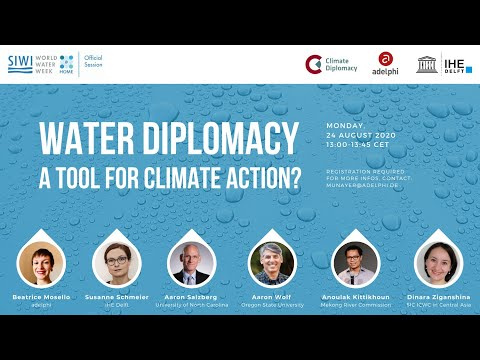
The panel looked at how water diplomacy interventions could be leveraged to encourage cooperation beyond water, showcasing experiences and lessons learned from different contexts and regions. The panel also reflected how diplomatic tools could be used to advance climate and security goals, looking into examples from Central Asia and the Mekong basin.
Susanne Schmeier started out by distinguishing water diplomacy from broader transboundary water management and cooperation, highlighting its use of diplomatic tools for objectives beyond water-related risks, including impacts on peace and stability. Schmeier noted increasing interest in this relationship from outside the water community, but also an increasingly nuanced understanding including an acknowledgement of concerns over securitisation and politicisation of water management. She noted important similarities to the debates over climate security, stressing that climate impacts would largely be felt through the water cycles. Approaches in both areas needed to be coordinated but also implied significant opportunities for mutual learning.
“This new focus on water diplomacy is largely driven by an interest in water-related security challenges from communities beyond the traditional water community.” — Susanne Schmeier, IHE Delft
Aaron Salzberg stressed that water was often a diplomatic bridge to address cross-cutting issues beyond water, promoting trust and cooperation and forcing countries to come together to address challenges such as climate change. This was true for government-to-government conversations, but especially for track 2 conversations including policymakers, scientists, and NGOs. Salzberg gave the example of the Sava River Agreement, which was the first agreement between Balkan countries after the conflict so that water served as the main vehicle for restarting cooperation among states in the region. He argued that foreign policy makers had a critical role in integrating other social and economic concerns into conversations while the water community focused on the more technical aspects. Salzberg concluded that process was often more important than the exact terms of an agreement, and that foreign policy could facilitate the trust necessary for managing the uncertainties and the need for continuous adaptation that climate change was bringing about.
“How countries continue to work together to solve the shared challenges [of climate change] is probably the most important outcome of a transboundary water process.” — Aaron Salzberg, University of North Carolina
Anoulak Kittikhoun emphasised the holistic nature of water diplomacy which included engagement on a legal framework; institutional setup; strategy; and, critically in his view, technical data. Yet agreements could be flexible to adapt to changes. By way of example, although the 1995 Mekong agreement did not dwell on climate change, this had been included into negotiation and planning and was now part of the regional water cooperation process. Member countries did not always agree on the exact figures, but usually on general trends and could therefore adapt measures and recommendations to deal with these issues. Adaptation of big projects towards more sustainable designs and in line with regionally agreed upon processes had been one of MRC’s big successes. Looking into the future, Kittikhoun underlined that climate change was a major issue and that riparians needed to discuss infrastructure adaptation.
“The discussion around […] options to deal with floods in the midst of a changing climate in the future needs to happen, and some of the decisions will be controversial. […] Diplomatic tools can aid in that process.” — Anoulak Kittikhoun, Mekong River Basin Commission
Dinara Ziganshina stressed that Central Asia would benefit from more multi-level diplomacy including at subnational level and public engagement. She highlighted the prominent role of local authorities and basin organisations in actively engaging in finding solutions to transboundary issues, contrary to the image of highly centralised decision-making. She stressed the need for Central Asian countries to have ownership and responsibility for cooperation, noting that most operational issues were already being resolved within the region. Ziganshina confirmed that there was a role for third party involvement, especially on discussing mechanisms for promoting monitoring and compliance, and for how to link technical discussions to broader strategic dialogues, but also stressed the need for including regional knowledge and engaging scientists from the region.
“[Local basin organisations in Central Asia] were always involved in technical, operational water management as ‘water managers’, but they are not so much involved in diplomacy-related practices. And I think we have to find a way to bring them to this discussion.” — Dinara Ziganshina, SIC ICWC Central Asia
Aaron Wolf emphasised that he did not expect any countries to go to war over water, and that stronger tensions usually brought the attention and resources for finding solutions. He explained that tensions were a function of the rate of change in a basin and its institutional capacity for dealing with those changes. Where the rate of change exceeded this institutional capacity, tensions would often rise. Climate change was both changing the hydrology and incentivising new infrastructure. To respond to this challenge, he emphasised the need to connect technical and political cooperation tracks. Whereas water agreements could only go as far as diplomats allowed, negotiations could push those boundaries, as shown by past negotiations between Jordan and Israel.
“A dam is, by definition, one of the major changes that can be brought into a basin. If there’s not an agreement in place on how to deal with the impacts of a dam, that is one of the things that can bring tensions.” — Aaron Wolf, Oregon State University
Many event participants asked questions which were subsequently discussed in the chat and by the panel. These broadly fell into four categories:
- Power, with questions on how to deal with international conflict, asymmetric power relations in negotiations at the national but also at the transboundary level, or how to get parties to the negotiation table especially if one party had limited interest in doing so;
- Discourse, with concerns over lack of trust and a politicisation of resources in the context of the water security and climate security debates;
- Implementations challenges, with questions on the effectiveness of cooperation, collaborative governance and win-wins such as trade, as well as the role of legal instruments and National Adaptation Programmes of Action (NAPAs); and
- Inclusion, with several questions on the role of women, youth, and regional organisations, as well as queries into how to foster the inclusion of these groups into the water diplomacy context.
In their responses, the panellists stressed the need to connect water experts with the political track, to be able to create incentives beyond the water sector itself and ensure that solutions were politically viable. Foreign policy could help create a suitable environment for negotiations and cooperation. Diplomacy and international law were mutually reinforcing, as diplomacy resulted in treaties and customs while law then defined the boundaries of what was possible. Regional organisations and local experts were crucial for generating context-specific data and knowledge, guaranteeing the inclusion of actors across the board, and ensuring that transboundary water management activities were true to the cooperation agreements. Panellists also stressed the need to invest in spreading and understanding stakeholders’ self-interest in collaboration. Finally, they emphasised that institutional capacity needed to be able to respond to change and highlighted the significance of an efficient science-policy-interface.


