


In recent years, a growing number of studies have appeared that analyse the statistical relationship between climate change and violent conflict. Whilst this research offers a comprehensive and systematic assessment of emerging climate-security risks, its results remain ambiguous, and are often misinterpreted. This is all the more serious, as quantitative evidence dominates current discussions on the security implications of climate change and, therefore, has a major bearing on policy-making.
In response to this problem, adelphi has published a concise overview of the quantitative literature on climate and conflict, which discusses the main findings of this literature and draws key lessons for policymakers.
A ‘cacophony of different findings’
Admittedly, at first sight, the statistical literature on climate and conflict looks a little messy. Researchers study an array of different types of violent conflict at different scales, and during different periods, including nomadic incursions in medieval China, violent crime in US cities, international disputes over shared rivers and ethnic conflicts across African and Asian countries. Matters are further complicated by the fact that there is no single agreed-upon measure of climate change and that researchers use a plethora of different indicators ranging from changes in average temperature to measures of disaster-incidence instead. Unsurprisingly, a literature with such heterogeneity in research designs does not converge towards a single robust finding, but has rather produced what experts such as Idean Salehyan have called ‘a cacophony of different findings’.
This might come as a disappointment to those seeking a unique and simple answer to the security challenges posed by a changing climate. If anything, the results of quantitative studies show that the effects of climatic shocks can be as diverse as their nature and the contexts in which they occur, requiring policy-makers to design specific solutions for specific problems in specific settings.
Context matters
What emerges more clearly from the statistical literature, however, is that certain countries, regions and social groups are more susceptible to experience violent conflicts in connection with climatic shocks than others. In particular, places where communities are vulnerable to adverse climatic conditions, institutions ineffective and essential services difficult to obtain have a higher risk of experiencing violent conflicts in connection with extreme temperatures and rainfall.
This finding corroborates the popular notion of climatic shocks as a ‘risk multiplier’ that can feed into, and aggravate already fragile political situations. It suggests that fragile places and communities risk to become even more so in the wake of climate change. It also allows identifying climate-fragility hotspots and directing preventive efforts.
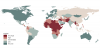
The following map derived from the Fragile States Index 2016, highlights the regions of the world where one or more of the above conditions interact to create a situation where climatic shocks increase the risk of violent conflicts. It is interesting to note that many high risk countries are located in regions that are also frequently exposed to climatic hazards, such as the Sahel, East Africa and the Middle East. These countries need to be at the centre of political efforts to curb climate-security risks.
Additional entry points for conflict prevention
Moreover, preliminary statistical evidence shows that vulnerable rural livelihoods play an important part in connecting climate and conflict in certain countries. Studies conducted in Colombia, Indonesia and Somalia show that where they emerge, climate-conflict connections are often mediated by the negative effect of climatic shocks on the livelihoods of vulnerable rural communities. In Somalia, for instance, droughts often lead to a decrease in livestock prices and thus also in the incomes of pastoralists. This in turn can be exploited by militant groups such as Al Shabaab to recruit fighters among destitute herders.
In reverse, this means that efforts to increase the resilience of rural livelihoods can go a long way in preventing climate-related conflicts. In places that are both vulnerable to climatic shocks and prone to social turmoil, climate adaptation and disaster risk reduction thus offer entry points for conflict prevention in addition to more conventional peacebuilding approaches.
That said, quantitative climate-conflict analysis is still a young discipline with its uncertainties and obvious limitations. Some of these relate to gaps in relevant data and are likely to be attenuated in the near future, as more and improved data become available. But others are inherent to the method itself, and become apparent when applying statistical techniques to concepts such as identity or animosity, which are difficult to measure and quantify. Caution is thus advised before taking the results of single quantitative analyses at face value. Instead, a systematic cross-evaluation of evidence from quantitative and qualitative sources is recommended.
Adrien Detges is a Research Analyst at adelphi, a Berlin-based think tank on climate, environment and development. He also conducts research on climate and security at the Freie Universität Berlin.


